

Data & Analysis
Central to much of the research of the Shared Waters Lab Partnership is the Transboundary Freshwater Diplomacy Database (TFDD) — the most comprehensive, freely accessible resource on international freshwater cooperation and conflict. It's used regularly by diplomats, policymakers, development partners, and researchers worldwide.
Explore the datasets below, and dive deeper into the research they support.
The TFDD: An Overview
The Transboundary Freshwater Diplomacy Database (TFDD) was founded by Prof. Aaron T. Wolf in 1995 at Oregon State University’s College of Earth, Ocean, and Atmospheric Sciences to provide a comprehensive resource on the world’s over 300 international river basins, their institutional governance mechanisms, and the extent of conflict and cooperation in transboundary waters. It includes the largest compendium of international water conflict and cooperation events, freshwater treaties, and joint basin institutions available anywhere. In addition to datasets, it includes primary source digital collections, map and image galleries, and details on an array of research and projects.
Datasets
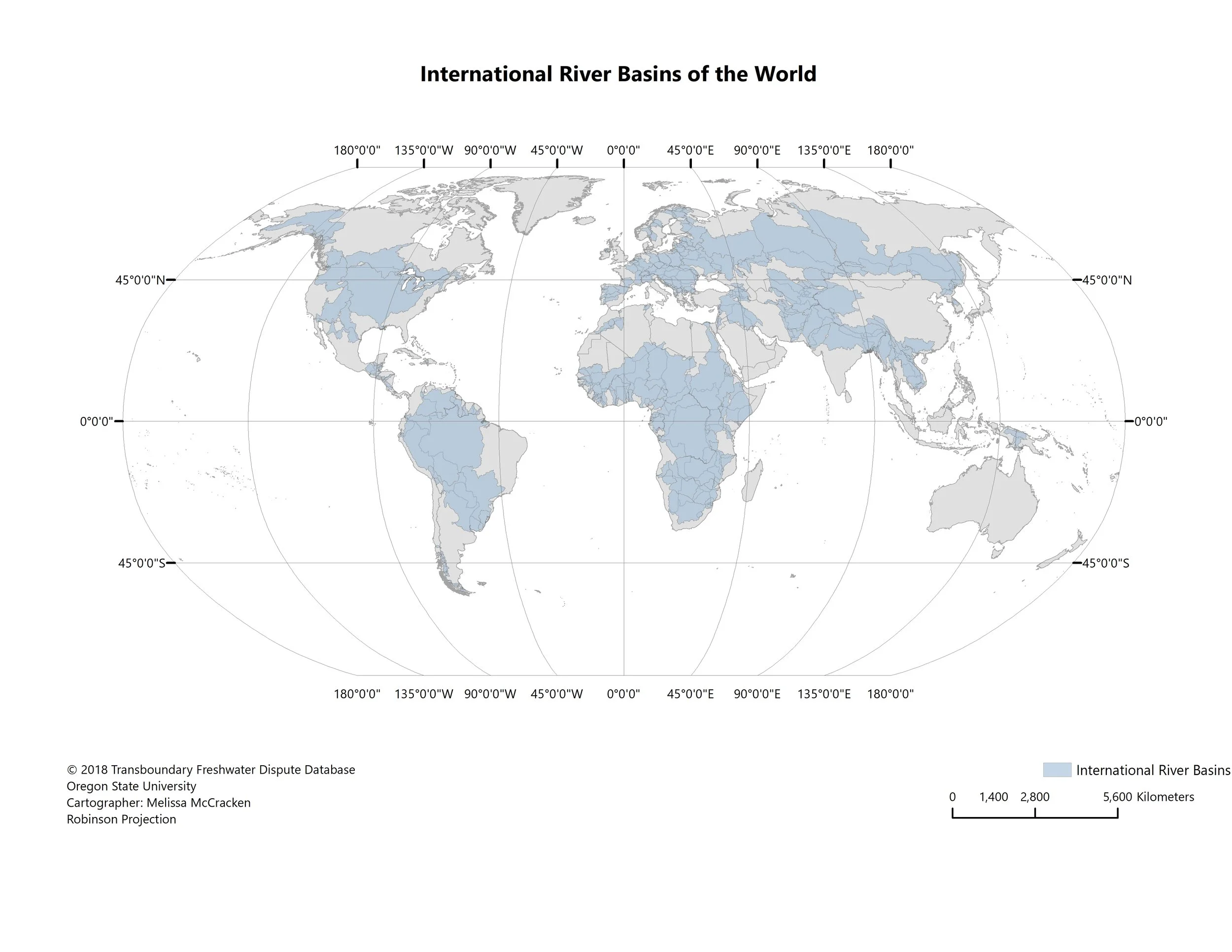
International River Basin Register and Spatial Database
Delineates the boundaries of the world's 312 international river basins, forming the geographic foundation of the TFDD and providing population, socioeconomic, and biophysical data for each basin. Includes the 2019 Register, available as regional maps and downloadable shapefiles.
International Water Event
Database
Over 6,400 historical international water interactions from 1948–2008, each coded for its level of conflict or cooperation intensity. Future updates are in process to extend coverage to 2025 and apply new data science methods to the collection process.
International Freshwater Treaties Database
More than 800 international freshwater agreements since 1820, including binding agreements and other non-binding documents such as declarations and MOUs that relate to international freshwater resources, with PDFs available for download when possible through Oregon Digital.
International River Basin Organization (RBO) Database
Institutional design data on more than 120 river basin organizations across 110+ transboundary watercourses, highlighting the commonalities and differences across RBOs in their design and function as they govern international watercourses.
The TFDD Explorer
We're in the process of a major update to the TFDD, building TFDD Explorer — a new interactive spatial platform that makes this data easier to access, visualize, and use — in collaboration with OSU Libraries and Press, Oregon Digital, Institute for Natural Resources.
From Data to Analysis: Key Findings
Our research applies this data to identify the following patterns in how riparians shared their transboundary water resources:
Cooperation Prevails Over Conflict
Since 1948, 77% of recorded water interactions have been cooperative, and only 19% involved conflict — though conflictive events have ticked up slightly since 2000. Scholars have noted complicating factors in these findings. First, conflict and cooperation can be present simultaneously, and second, not all cooperation is unambiguously positive: some agreements cement existing power imbalances rather than resolve them.
Water Quantity and Infrastructure Drive Tension
Most conflicts concern disputes over water quantity or the unilateral development of shared resources, such as through dams. Dam development is accelerating across the Global South as countries pursue renewable energy and climate adaptation through greater storage capacity — raising the potential for tension.
Institutional Capacity Is Essential but Stagnating
Despite the importance of institutions to water cooperation, the rate of new treaty signings has declined since the 1990s, and only few new RBOs have formed since 2002. Just 14% of the over 800 treaties and legal documents we've studied address an entire river basin — most remain bilateral even within multilateral basins, complicating the integrated basin management called for under UN SDG 6.5.
Dive Deeper with Core Publications
-
International River Basins of the World. Wolf, A., Natharius, J., Danielson, J., Ward, B., and Pender, J. (1999).
International Journal of Water Resources Development, 15(4), 387–427.
The foundational study establishing the geographic scope of the world's international river basins.
[Read the paper →]
Updating the Register of International River Basins of the World. McCracken, M. and Wolf, A. T. (2019).
International Journal of Water Resources Development, 35(5).
Revisits and updates the original 1999 basin register, forming the geographic backbone of the TFDD's spatial data.
[Read the paper →] -
Patterns in International Water Resource Treaties: The Transboundary Freshwater Dispute Database. Hamner, J. H. and Wolf, A. T. (1997). Colorado Journal of International Environmental Law and Policy, 9(3).
The founding study analyzing patterns across international freshwater agreements, establishing the basis for what became the TFDD's Treaties Database.
[Read the paper →]Governing International Watercourses: River Basin Organizations and the Sustainable Governance of Internationally Shared Rivers and Lakes Schmeier, S. (2013). Routledge.
A comparative study of river basin organizations worldwide, with in-depth case studies of the Senegal, Mekong, and Danube basins, examining what makes these institutions effective.
[Link to book →] -
International Waters: Identifying Basins at Risk Wolf, A. T., Yoffe, S. B., and Giordano, M. (2003). Water Policy, 5(1), 29–60.
Finds that institutional capacity and rapid change — not water scarcity alone — are the strongest predictors of international water disputes.
[Read the paper →]Defining Effective Transboundary Water Cooperation McCracken, M. (2022). Routledge.
Develops frameworks for defining and evaluating what makes cooperation over shared water resources genuinely effective — addressing a longstanding gap in how "cooperation" is measured in policy and practice.
[Link to book →] [Preview Chapters →]Reflections on Transboundary Water Conflict and Cooperation Trends Turgul, A., McCracken, M., Schmeier, S., Rosenblum, Z. H., de Silva, L., and Wolf, A. T. (2024). Water International, 49(3–4).
Revisits decades of conflict-cooperation event data to examine what's changed — and what hasn't — in transboundary water relations.
[Read the paper →]